New Canadian research highlights racial inequities in maternal health
October 20, 2026
A new study pufblished by the Canadian Medical Association Journal (CMAJ) highlights important evidence supporting the existence of racial inequities in maternal health outcomes across Canada. The study, "Racial inequities in severe maternal morbidity among Black and white people in Canada," found that Black people experience significantly higher rates of serious pregnancy-related complications, such as severe preeclampsia, hemorrhage and sepsis, than white people, regardless of socioeconomic or other clinical factors.
This research was a product of interprofessional collaboration involving midwives, doulas, other obstetrical care providers and members of the Black Reproductive Health Working Group, and was conducted through the Canadian Network for Health Equity Using Advanced Data Linkage (CanHEAL). Midwives were important contributors to the research team, including co-authors Karline Wilson-Mitchel, Aderemi ('Remi) Ejiwunmi, Feben Aseffa and Shani Robertson.
What did the research find?
The study drew from nearly 1.5 million births between 2012 and 2023 to examine severe maternal morbidity (SMM) and includes serious pregnancy-related complications involving prolonged hospitalizations or increased risk of death.
The findings reveal persistent racial inequities in maternal health across Canada (excluding Quebec):
-
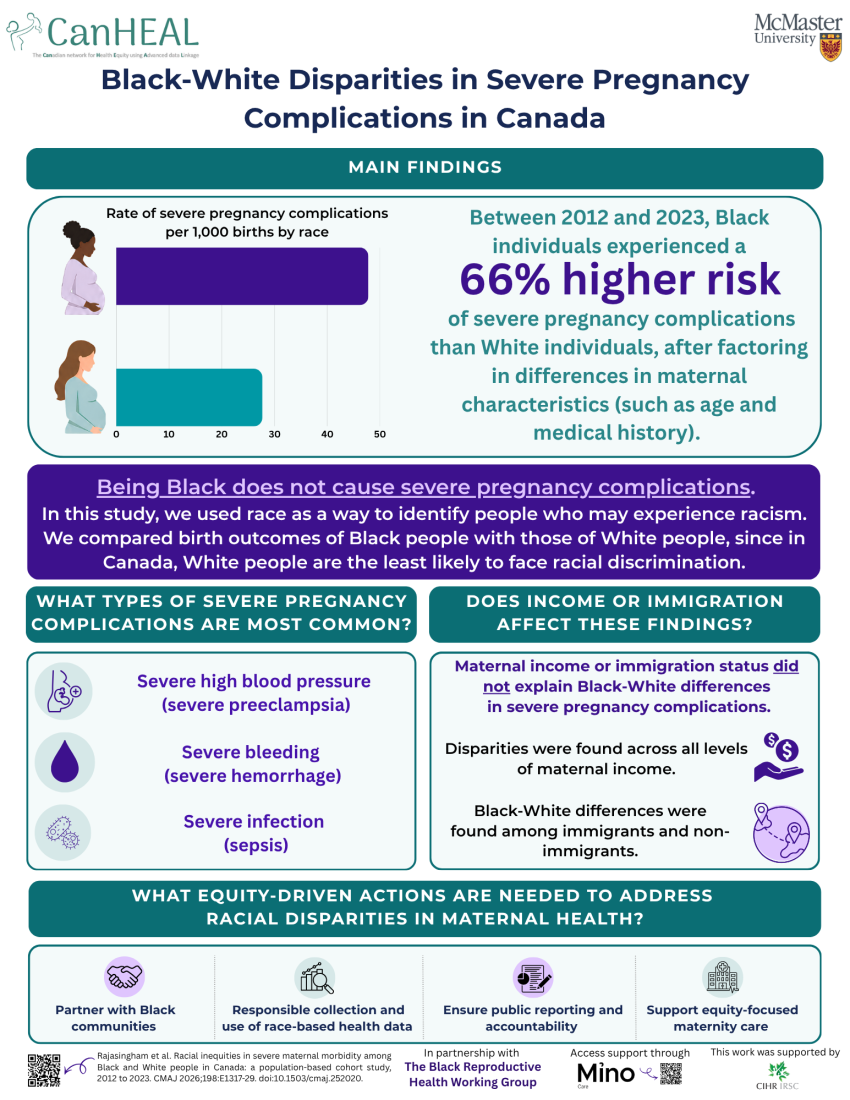
Black people experienced 66% higher odds of severe maternal morbidity compared with white people.
-
Overall, SMM occurred at a rate of 47.8 per 1000 births among Black people, compared to 27.7 per 1000 births among white people.
-
Racial disparities persisted across all socioeconomic / income levels, immigration categories and provinces throughout the study period (2012-2023).
Interestingly, higher household income was associated with lower rates of severe maternal morbidity (SMM) among white people but higher among Black people. This challenges the assumption that socioeconomic advantage is enough to protect individuals against racial health inequities. Instead, the researchers suggest that the cumulative effects of structural and interpersonal racism, differences in access to health and social services, chronic stress and other social determinants of health could possibly contribute to these disparities.
Advancing equity in maternal health
The study reveals the necessity to address how structural and systemic factors contribute to the findings which clearly indicate inequities in the reproductive and perinatal health sector, especially pertaining to race-related inequities. The authors emphasize the importance of informed and culturally responsive care models, forming meaningful relationships with Black communities when designing and evaluating health-care services, and continuous collection of race-based health data.
For midwives, this research sheds light on the importance of addressing racial inequities throughout pregnancy, birth and postpartum care. Midwives not only provide health-care services, but specifically client-centred care that puts an emphasis on relationship building and trust. Midwives also play an important role in challenging anti-Black racism within the health-care sector, advocating for systemic change and providing equitable, respectful and responsive care to improve maternal health outcomes.